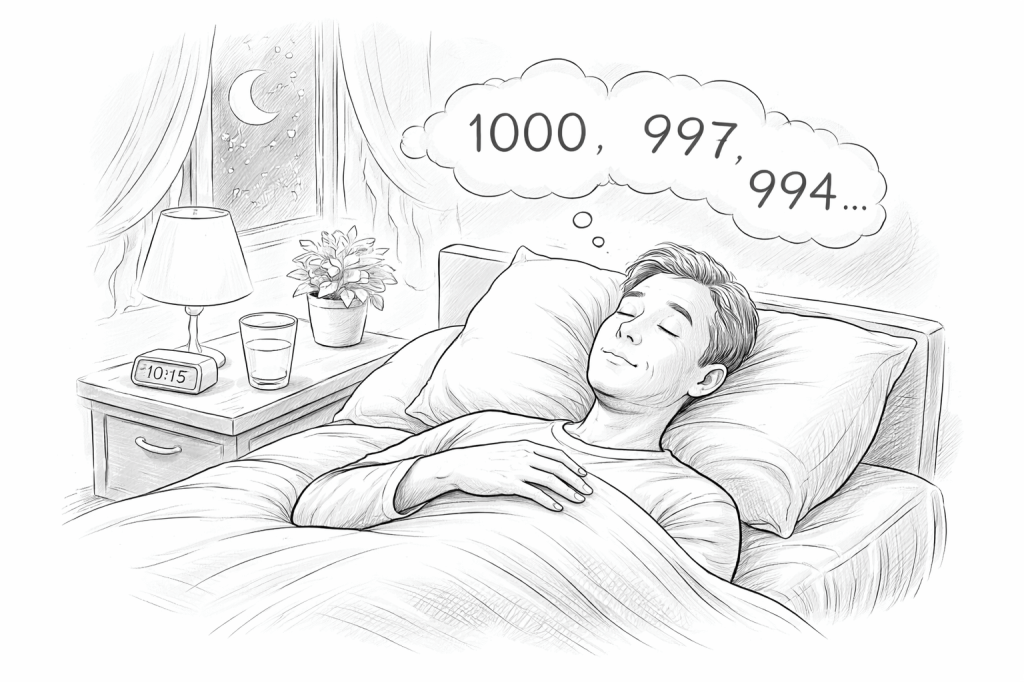
For a long time, getting to sleep was less about tiredness and more about what my mind chose to do when the lights went out. Thoughts would arrive uninvited — sometimes anxious ones, sometimes creative ones. Ideas, phrases, connections. Perfectly reasonable thoughts, just turning up at the wrong time.
What I needed was not silence, but less space for those thoughts.
The basic method
The core of the strategy is simple.
I begin at 1000 and slowly subtract 3 each time:
1000, 997, 994, 991, and so on.
I do this gently, without rushing. If I can hear my heartbeat, I often let the rhythm of the counting follow it, one digit at a time. There is no target speed and no requirement to “do it properly”.
If sleep hasn’t arrived by the time I get down to around 300, I deliberately take the pressure off by allowing myself to restart at 1000. There is no sense of failure attached to restarting. It is simply part of the method.
At first, this worked well as a way of blocking out unwanted thoughts altogether. The counting occupied my attention just enough to let sleep take over.
Discovering two threads
Over time, I noticed that the thoughts didn’t always stay away. They would sometimes continue alongside the counting. What surprised me was that this didn’t automatically break the method.
It felt as though my mind could run on two threads at once:
- one thread doing the counting
- another thread still generating thoughts
Rather than fighting this, I adapted the strategy to make use of it.
Back bearings and markers
The first adaptation was to introduce what I think of as back bearings and remembered landmarks. Back bearings allow me to check that I am still a multiple of 30 away from where I started at 1000. Landmarks tell me roughly where I am in the sequence.
Every time the last digit of the number is zero, I know I’ve reached one of these markers. Starting at 1000, I know the first one will appear at 970, then 940, then 910, and so on.
Some of these become more significant simply because they stand out:
850, 700, and similar points.
I don’t do anything with these numbers. I just notice them. They act as a kind of gross-level checksum, reassuring me that the counting is progressing as expected.
This gave the second thread something dull but structured to occupy itself with.
Forward bearings
Later, I noticed another pattern I could use if needed.
In each group of ten decrements, the trailing digits 0 to 9 appear once, and once only, but not in numerical order. Each trailing digit tells me how many steps remain before the next multiple of ten.
For example:
- a number ending in 9 tells me a multiple of ten will appear in three steps
- a number ending in 7 tells me the multiple of will appear in nine steps
This creates a forward bearing — a quiet sense of what is coming next — which can be enough to steady attention if thoughts start to intrude again.
I don’t consciously apply this all the time. It’s simply there if I need it.
If I can’t handle consideration of these back and forward bearings within the rhythm of the countdown, I simply let it go and don’t worry if I’ve gone off course with the basic countdown whether it’s in error or not. I can pick things up later.
Where this leaves things
This strategy doesn’t eliminate all thoughts, and it doesn’t need to. Its value lies in giving the mind something predictable, neutral, and repetitive to work with, while removing any pressure to succeed.
I still use this approach.
When it became less effective at one point, I experimented with an alternative: silently naming random words in my head, taking care not to repeat them. That felt lighter, and easier — but it also marked the point at which something new began to happen during the day.
Those daytime mind pops are a story for another post.
I’m sharing this in case it’s useful to others navigating similar territory.


Leave a comment