In a previous post, I described a counting-based strategy I use to get to sleep. When that approach began to lose its effectiveness, I tried something different.
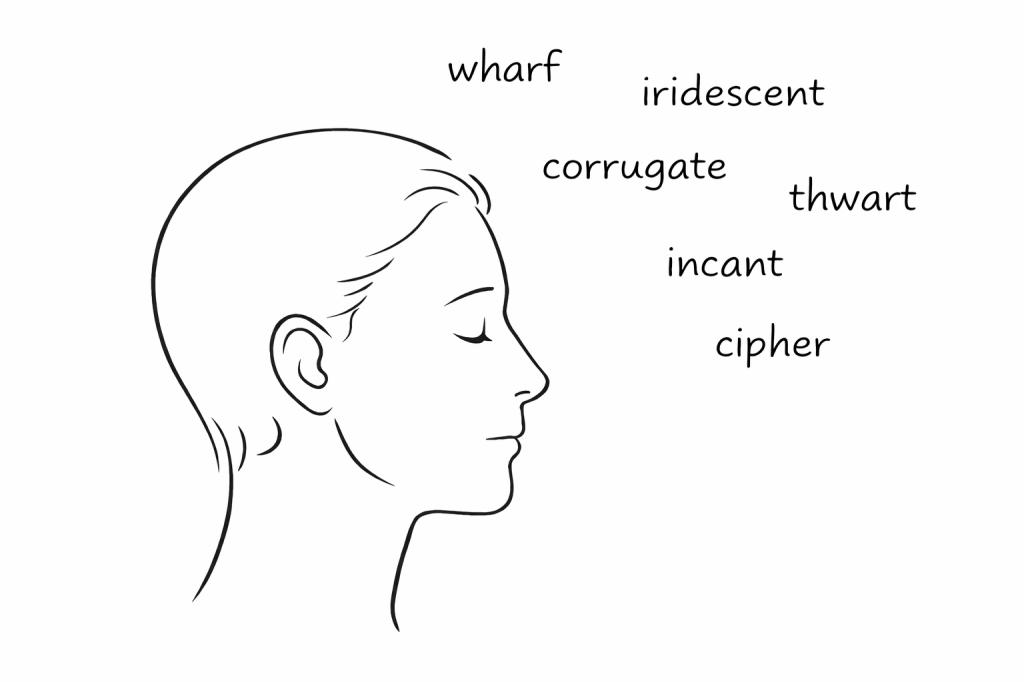
Instead of numbers, I silently generated random, unconnected words, taking care not to repeat any of them. It felt lighter and less effortful than counting, and I wasn’t surprised to find that I could do it easily.
That ease had a history.
Where the idea came from
For many years I had listened to I’m Sorry I Haven’t a Clue, a long-running radio panel game on BBC Radio 4, which sometimes included a round in which panellists took turns producing words that were completely disconnected from the previous one. No links. No associations. Just a clean break each time.
I’d also adapted this idea into a family Christmas parlour game, which is where I first noticed that I was rather good at it. Producing disconnected words felt natural, almost playful.
So when my counting-down-in-3s strategy began to fail, it seemed reasonable to draw on that experience and try something new.
At first, it worked well.
What changed
What I didn’t expect was that I couldn’t stop doing it.
Quite suddenly, sequences of random words began appearing in my mind during the day, without invitation or intention. They would simply pop into my head, fully formed, and then pass.
This wasn’t happening at night, or when I was tired. It was happening in ordinary daytime moments. And it kept happening.
This began around four years ago, and it continues to this day — a few times a day, every day.
At the time, I genuinely thought I was going mad.
Finding a name
Eventually, I did what many people do when something unfamiliar persists: I looked it up.
That was when I discovered that this experience has a name. It is a recognised and documented phenomenon, usually referred to as mind pops.
Finding that term mattered more than I expected. It didn’t explain everything, but it replaced fear with context. This wasn’t unique to me, and it wasn’t unknown.
A small measure of control
After a while, I noticed something else.
If I silently said the word “dictionary” in my head, the stream of random words would stop — at least temporarily. My own logic was simple: all the words were safely contained there, so they didn’t need to keep arriving.
I don’t claim this makes any particular sense, and I don’t fully understand why it works. It just does, often enough to be useful.
I’m aware that this sounds odd. But discovering even a small degree of control was enormously reassuring.
Where this leaves me
I still experience mind pops. They haven’t escalated, and they aren’t distressing in themselves. What was distressing was not recognising them, and not having a name for what was happening.
Looking back, one contrast stands out.
My original sleep strategy was structured, bounded, and predictable. The random-word strategy was deliberately unstructured and open-ended. One seemed to contain thought; the other appeared to let it roam more freely, even beyond sleep.
I’m not drawing conclusions here. I’m simply recording what happened.
I’m sharing this in case it’s useful to others navigating similar territory.
Further reading (optional)
The term “mind pops” appears in cognitive psychology literature describing spontaneous, involuntary verbal or semantic intrusions. I found it reassuring to learn that this is a recognised phenomenon, discussed by researchers, even if explanations remain incomplete.


Leave a comment