There’s a particular kind of moment that I’ve come to recognise over the years. It doesn’t arrive with a bang. It creeps in.
It tends to happen in the most ordinary of settings — a meal out, a gathering with half a dozen conversations flowing at once. Nothing unusual. Nothing dramatic.
And yet, something begins to change.
At first, I’m absolutely fine. I can follow the conversation, contribute, smile at the right moments, keep track of who is saying what. It all feels perfectly normal.
Then, gradually, almost imperceptibly, the effort increases.
Words don’t come quite as easily. Thoughts feel a little slower to form. It’s not confusion — that’s important — it’s more like everything has become… thicker.
I used to think of it simply as brain fog — and that’s a perfectly reasonable way of describing how it feels.
But over time, I’ve come to see a pattern behind it.
Too Many Streams at Once
What I’ve come to understand is that it isn’t any one thing causing the problem. It’s the combination.
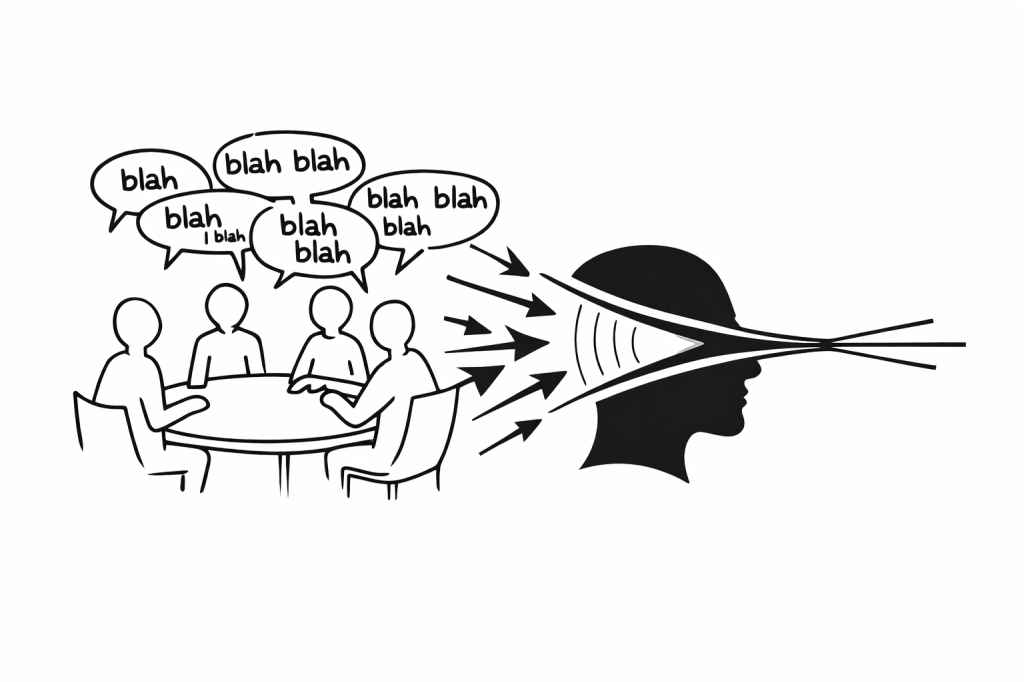
Multiple people speaking.
Voices overlapping.
The need to turn left, then right, then back again.
The quiet social pressure to stay engaged — to nod, to respond, to be part of it.
Each of these, on its own, is manageable. Together, they create a kind of load.
And that load builds.
There comes a point — and it’s surprisingly consistent — where the brain fog feeling begins to appear.
A Ceiling, Not a Decline
One of the most important realisations for me has been this:
This isn’t my thinking breaking down.
Because if I step away — even just for ten minutes — the brain fog lifts. Clarity returns. Words flow again. The fog clears, often on the quiet walk home.
If this were a general cognitive problem, that wouldn’t happen.
In a one-to-one conversation, in a calm setting, there’s no fog at all.
Which leads me to a slightly different way of understanding it.
Sensory Bandwidth
The phrase I’ve settled on is sensory bandwidth.
What people often call brain fog, in my case, seems to be the point at which my sensory bandwidth is saturated.
In complex environments — lots of voices, movement, and social signals — there is simply more coming in than I can comfortably process at once.
It’s not a loss of ability. It’s a limit on how much can be handled simultaneously.
A bit like trying to run too many applications on an older computer. Each one works perfectly well, but there’s a point where the system starts to slow — not because it’s broken, but because it’s full.
The “fog” is what that fullness feels like from the inside.
Learning the Threshold
Over time, I’ve noticed a pattern.
There’s a period where I’m coping well.
Then a gradual build-up of effort.
Then a moment of recognition — the fog is starting to creep in.
And after that, the sensible thing is to step away.
If I leave it too long, the fatigue lingers for the rest of the evening. If I act early, recovery is much quicker.
So it’s become less about pushing through the fog, and more about recognising what’s causing it.
Adjusting, Not Withdrawing
This has had its practical consequences.
I’ve had to rethink how I take part in things like Rotary — moving to a form of membership that keeps me connected without placing me repeatedly in the most demanding environments.
That hasn’t always been an easy shift. But it’s been an important one.
Because this isn’t about giving things up.
It’s about understanding the fog — and working around the conditions that bring it on.
A Different Way of Understanding
For a long time, experiences like this can feel vaguely worrying. It’s easy to wonder what they might mean.
But for me, the key insight has been this:
The brain fog isn’t random.
It’s a predictable, repeatable response to a specific kind of situation.
A ceiling, rather than a slope.
And once you start to see it that way, it becomes something you can work with — rather than something to be quietly concerned about.
In Short
What many would call brain fog,
I’ve come to recognise as sensory overload reaching a limit.
Not a failure of thinking,
but a ceiling of what can be processed at once.
And learning where that limit sits has made all the difference.
 Half a Mind to ..
Leave a comment