Half a Mind to ..

Life after brain injury – one small victory at a time.

Tag: challenge

  • The Email Beast (challenge 106)

    The Email Beast (challenge 106)

    There are days when email feels like a friendly tool.
    A note from a friend, a reminder of something pleasant, a quiet nudge about a parcel in the post.

    But more often than not, it turns into something far larger.
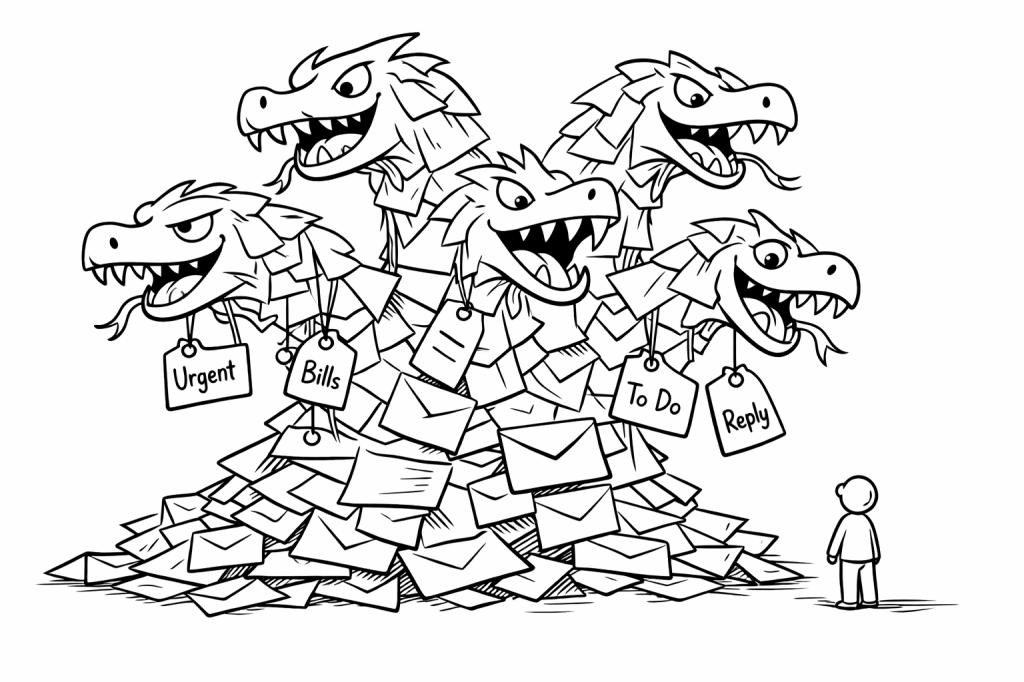
    For me, it often feels like a living creature — growing, demanding, and constantly calling for attention. One unanswered message becomes two. Two become twelve. Before long, the inbox stops being a place I visit, and becomes a shadow that follows me around the day.

    Read more: The Email Beast (challenge 106)

    Part of the difficulty is my brain injury and stroke.
    I no longer read, remember, and respond to messages in the effortless way I once did. If I skim an email and move on, there’s a fair chance I’ll forget it entirely. If I leave it unread, the number sitting in red starts to climb — and with it, a knot of anxiety tightens.

    And the truth is, email isn’t just “email.”
    It’s:

    • appointments I mustn’t miss
    • bills that need attention
    • tasks that require thinking
    • parcels on their way
    • messages from people I care about
    • and endless newsletters that I never asked to receive

    All of these live together in one place, and my brain struggles to tell them apart.

    So the “email beast” isn’t imaginary.
    It’s the very real feeling that I am being asked to hold far more in my head than I have space for. And the cost — when things get missed, forgotten, or muddled — is frustration, guilt, and sometimes embarrassment.

    But naming a challenge is the first act of taming it.
    In the next few posts I’ll share the methods, workarounds and habits that are helping me bring this beast to heel — slowly, gently, and in a way that suits the brain I now have.

    One small step at a time.

    Related Posts

  • Fatigue (Challenge C013)

    Fatigue (Challenge C013)

    People often think fatigue is just another form of tiredness, but my experience has shown me how different they are. Tiredness is the ordinary, end-of-the-day feeling that settles after a period of effort and usually disappears with a good rest. Fatigue, on the other hand, has been a long-standing companion since my brain tumour treatment in 2008 and again after my stroke. My brain now works much harder behind the scenes to do everyday things — concentrating, navigating, seeing — and that hidden workload drains my energy far more sharply than seems obvious from the outside. Sleep doesn’t always put things right. Fatigue can arrive suddenly, linger stubbornly, and needs managing rather than simply ‘pushing through’. It’s not about attitude; it’s the reality of a brain that’s had to rebuild itself twice.

    The Brainstrust charity does a great job on explaining fatigue for people with brain tumours here…

    https://brainstrust.org.uk/brain-tumour-support/quality-of-life/living-well-with-a-brain-tumour/fatigue/

  • Visual Field Loss – (Challenge 001)

    Visual Field Loss – (Challenge 001)

    I have left-sided hemianopia (or Hemianopsia, which means I cannot see the left half of my visual field; true for both eyes. To a great extent I am unaware of the issue in for the most part daily life these days. There’s no additional edge or the like in what I see, it simply tails off into nothingness in the same way that a normally sighted person experiences. There’s just less information coming in.

    Seventeen years ago, after surgery required sacrificing part of my vision, I would bump into people or objects on my left side almost daily. Although I rarely bump into things now, certain environments remain difficult to navigate.


    In particular, walking through areas of medium crowd density is most challenging. When people have the space to move and change direction unexpectedly, it is very difficult for me to anticipate their movements on my blind side. Low crowd density situations pose fewer problems, and very crowded spaces can actually be easier to manage because movement is slower and more predictable.


    Related Posts

    Related topics – Ch:xxx getting insurance, Driving license, In:xxx:visual field loss