For a long time, getting to sleep was less about tiredness and more about what my mind chose to do when the lights went out. Thoughts would arrive uninvited — sometimes anxious ones, sometimes creative ones. Ideas, phrases, connections. Perfectly reasonable thoughts, just turning up at the wrong time.
What I needed was not silence, but less space for those thoughts.
The basic method
The core of the strategy is simple.
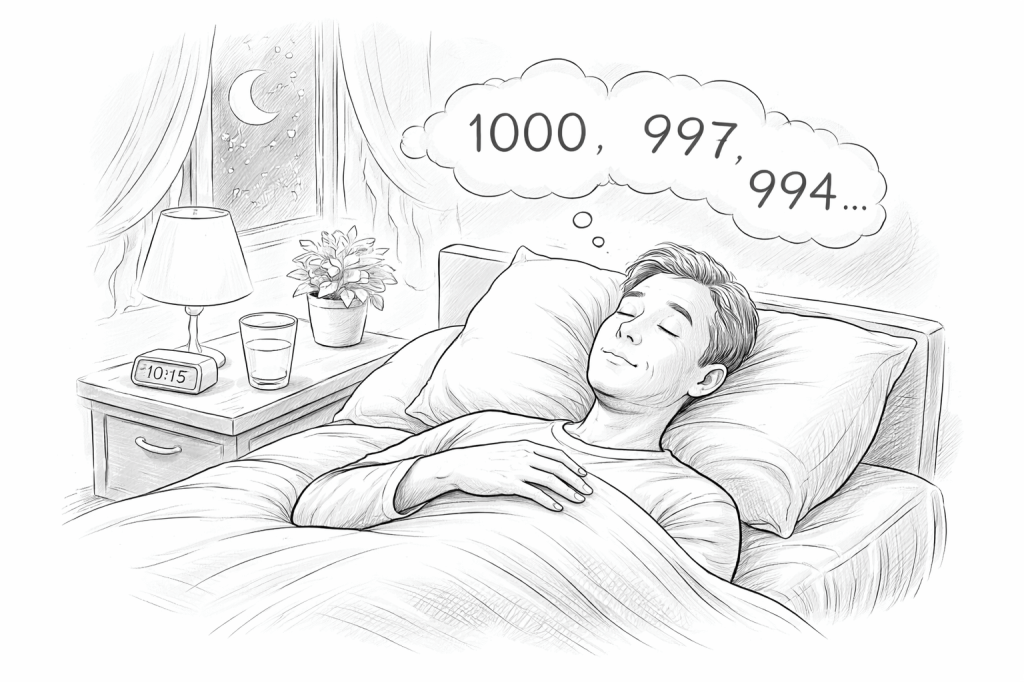
I begin at 1000 and slowly subtract 3 each time: 1000, 997, 994, 991, and so on.
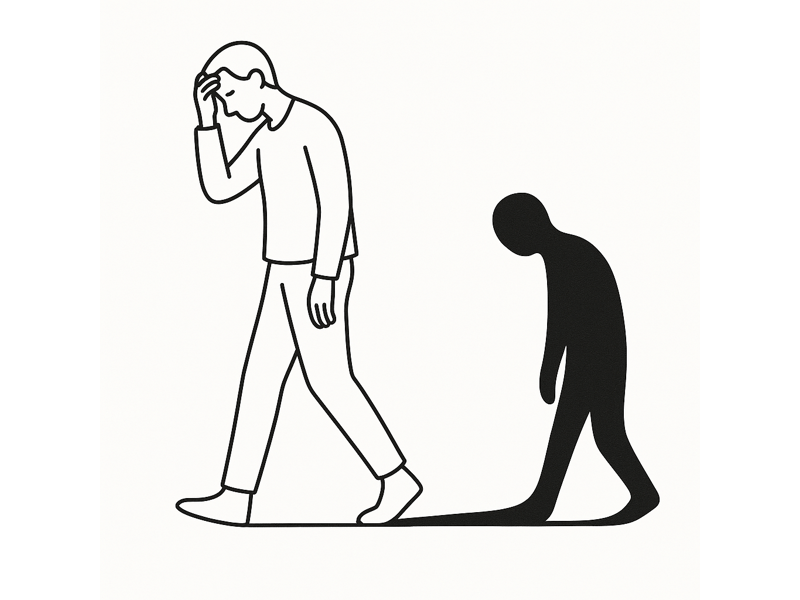
People often think fatigue is just another form of tiredness, but my experience has shown me how different they are. Tiredness is the ordinary, end-of-the-day feeling that settles after a period of effort and usually disappears with a good rest. Fatigue, on the other hand, has been a long-standing companion since my brain tumour treatment in 2008 and again after my stroke. My brain now works much harder behind the scenes to do everyday things — concentrating, navigating, seeing — and that hidden workload drains my energy far more sharply than seems obvious from the outside. Sleep doesn’t always put things right. Fatigue can arrive suddenly, linger stubbornly, and needs managing rather than simply ‘pushing through’. It’s not about attitude; it’s the reality of a brain that’s had to rebuild itself twice.
The Brainstrust charity does a great job on explaining fatigue for people with brain tumours here…
I’ve blogged about my sensory overload before (Ch002). Finding a restful place, or getting off to sleep at night, with a bit of background sound — a podcast, some music, or a familiar voice reading a book — can be very helpful, especially when thoughts won’t stop churning. The trouble is, most gadgets seem to assume we all want things louder, not quieter. For me, even the lowest possible setting on my phone or phone and speaker combination is too much. After a bit of head-scratching, I finally found a simple, old-fashioned fix that works beautifully.
If sleep isn’t happening soon enough, I try drifting off to the sound of something gentle — but neither my phone alone, nor my phone and Bluetooth speaker combination could produce a sufficiently quiet sound. Both have volume controls that only work in steps from one to ten, and even with both turned right down, the sound was still too loud in the stillness of the night. When I searched online for a fix, all the advice seemed to be about boosting the volume, not softening it.
Eventually, I came up with my own solution. It’s not rocket science, but when I was struggling to find my way in the new normal, it isn’t something I was able to think about early on.
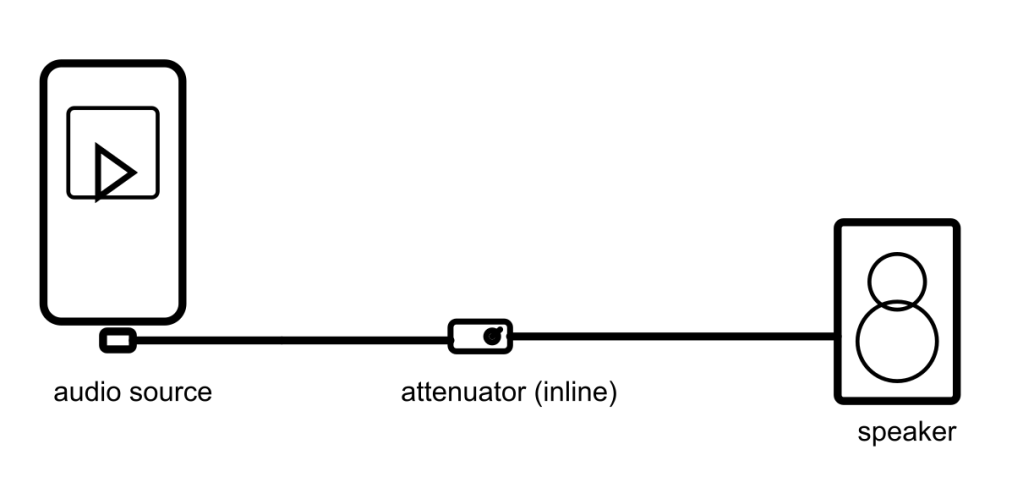
I started using a little gadget called an attenuator — a small box that sits between the audio source (in my case, my phone via a lightning-to-audio adapter) and a speaker with a 3.5mm headphone jack (not so common these days!).
The joy of the attenuator is its analogue dial. It lets me make smooth, gradual adjustments, right down to a whisper. With a bit of practice, I learned to roll my thumb gently over the dial to fine-tune the sound to the perfect level — just audible, but soft enough not to wake me again later.
I did try a Bluetooth version, using a relay with the attenuator in between, but it was all a bit too fiddly — extra cables, another thing to charge, and more potential for something not to connect. In the end, the simple wired setup won hands down: quiet, reliable, and delightfully uncomplicated.
It’s a small tweak, but it’s made bedtime so much smoother. Sometimes, the old-fashioned wired approach still does the job best.
My kit is the cubilux attennuator https://amzn.eu/d/hCjidW1 and the Anker speaker … https://amzn.eu/d/e3AiXCZ with a 3.5mm male to male audio cable, and a long 3.5mm male-female audio extension cable, plus the iPhone lightning to 3.5mm adapter.

 Half a Mind to ..