“I can’t see it.”
The first time I remember saying this after my brain surgery, I was lying in a hospital bed, only a few hours after waking up. A nurse brought me a small pot containing pills. When I said those words, she immediately went to get a doctor to check my eyesight.
Her concern was understandable. This was the first opportunity to assess what the surgery had meant for my vision. My surgeon had faced the difficult balance between removing malignant tissue and the risk of leaving me with further disability.
Looking back, what interests me is how difficult it was to explain what “I can’t see it” meant. Those were the words I had available. They did not necessarily distinguish between missing visual information and being unable to make sense of what was there.
I have another vivid memory from when I first woke up. My surgeon came to see me, and his face looked like a Picasso picture: the elements were there, but they seemed disjointed rather than forming the familiar arrangement of a face.
I don’t know whether that early experience and the difficulties I have now share the same explanation. But it remains a striking example of how looking at something and perceiving it as a coherent whole can be different experiences.
Over the years, I’ve had many visual field tests. These have helped me understand where the gaps in my vision are, mostly towards the bottom left. But knowing where those gaps are doesn’t fully explain the experience of looking at something and being unable to make sense of it.
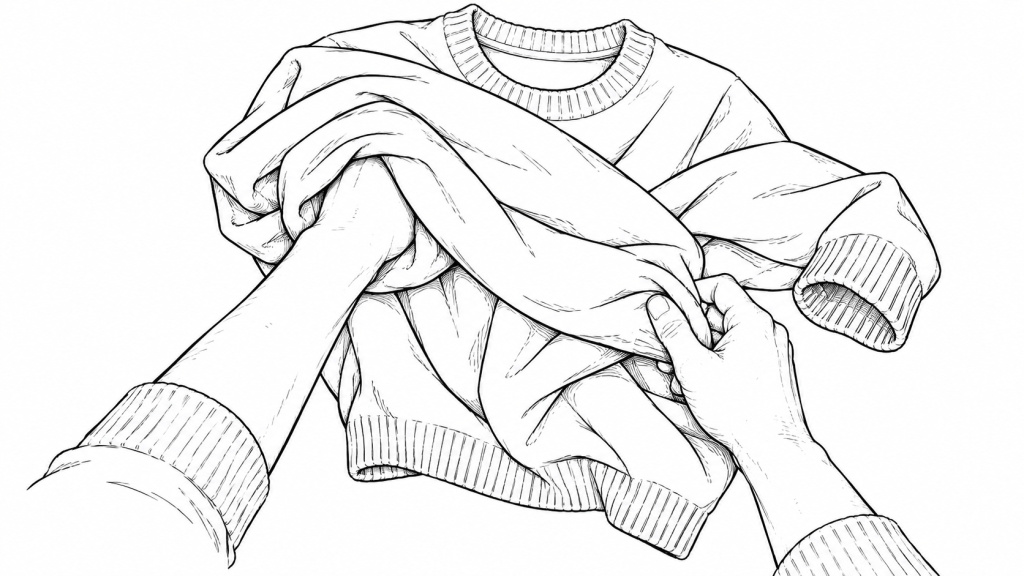
A recent example involved the sleeves of a plain dark jumper. I was trying to untangle them. I could see the jumper, but I couldn’t readily work out how the different parts were arranged or where to put my hand.
Getting dressed ought to be straightforward. But before I could sort out the sleeves, I needed to understand what I was seeing. That was the part that wasn’t coming together.
My background in computer vision gives me a way of thinking about this. Capturing an image is only the beginning. Making sense of it—identifying objects, their boundaries and how they relate to each other—is a much bigger task.
I wonder how much harder that task becomes when the available information is incomplete, sparse or difficult to distinguish. A plain dark jumper offers few obvious clues to separate one fold from another. Perhaps gaps in my vision leave me with fewer clues still. That is a way of thinking about the difficulty, rather than a claim to know exactly what causes it.
I also wonder how much my brain has adapted over the years, and what part neuroplasticity—the brain’s capacity to change and adapt—has played. I can’t answer that from my own experience, but it makes me curious about how I have learned to manage with the information available.
With the jumper, I needed more than an awareness of dark fabric. I needed to recognise which bit was which and where an opening led. Until then, I didn’t have the information I needed to act.
This matters when we explain our difficulties to other people. If someone says they can’t see something, it is natural to direct their attention towards it. But their attention may already be in the right place. They may need help understanding what is there.
It also matters in how I think about myself. Struggling with a jumper can feel absurd. Remembering that an apparently simple task contains a less obvious task—understanding the scene—helps me put that struggle into perspective.
For me, seeing is perceiving. It is reaching the point where what is in front of my eyes becomes meaningful and usable.
Until that happens, “I can’t see it” may be exactly what I mean.

