I needed a different way to think
After my brain injury, I gradually realised that some tasks were failing for a reason that had little to do with whether I understood them. I could understand a problem perfectly well and still lose my place in it. An interruption could displace what I had been holding in mind within seconds. Sometimes the limitation showed itself in much smaller ways: give me two pieces of spoken information in quick succession and the second could simply push the first one out.
That mattered at work. I had moved from highly creative technical work into deep system testing, where I might have to follow a problem through layers of software and preserve what I had discovered along the way. Disability adjustments gave me some protection and, importantly, room to experiment. But I did not merely want to remain employed. I wanted to contribute.
I had known about mind maps for years. I can remember conventional mind maps going back as far as school, and I had used them occasionally before my brain injury. But I thought of them largely as diagrams: a way of representing information I had already thought about. The important change came when I stopped asking how to make a better list or a better diagram and started asking a different question: where could the thinking itself live?
I needed a different way to think.
Thinking outside my head
The phrase ‘thinking outside the box’ is familiar. What I increasingly needed was something more literal: thinking outside my head.
A list can remember things for me, and that is useful. But many real jobs are not static. They grow, shrink, branch, change state and contain uncertainties. The question I needed to answer at the beginning might not be the question I needed to answer ten minutes later.
A mind map gave me somewhere external for that changing structure to live. I could add a thought immediately, rearrange it, park a question, return to an earlier branch, or mark something as complete. If I was interrupted, the task did not disappear with the contents of my working memory. I could come back to the surface and see where I had got to.
This can make an enormous difference to cognitive burden. The task itself may still take time, but the amount of it that I have to hold inside my head at any one moment can become very small.
A working surface with state
The distinction that matters to me is between a mind map as a diagram and a mind map as a working surface. A diagram describes something. A working surface participates in doing it.
On my working maps, nodes can change colour, move to different branches, acquire reminders, or act as temporary markers. I often use conspicuous cloud styling for cursor nodes: ordinary nodes whose text tells me the job of that cursor and whose position records where I have reached. I may have more than one cursor on a map, each holding a different place in a process.
The map therefore remembers more than information. It remembers state: what I have considered, what is still uncertain, what has been deferred, what is partly done, what is complete, and where I should resume.
FreeMind is the tool in which I developed these techniques, so some of the details I describe are FreeMind features. The underlying principle is not dependent on FreeMind. What matters is having an external surface that can change with the work.

Packing for camp: the working surface in motion
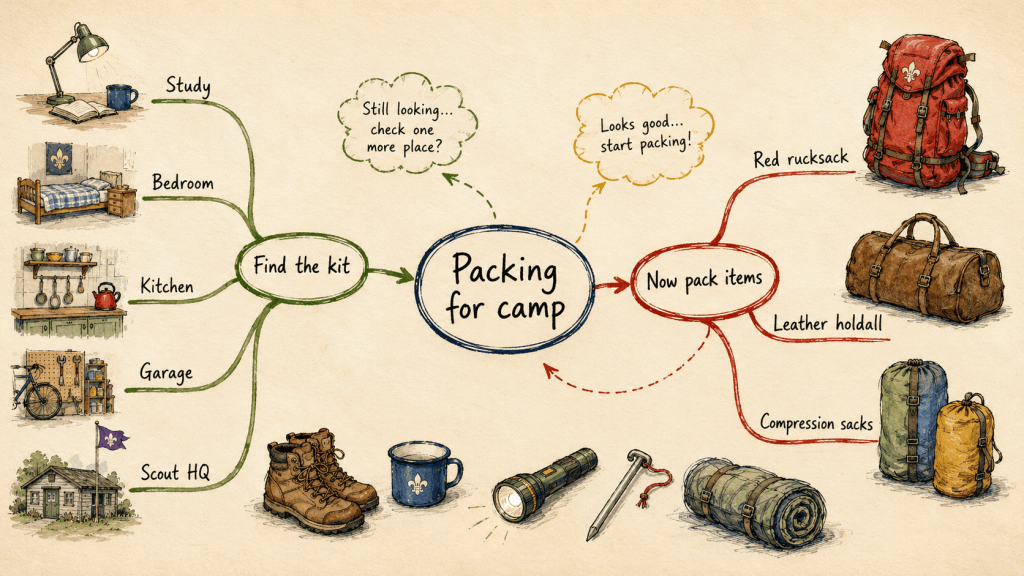
Packing for a trip became one of my clearest examples. Before developing this approach, getting ready could consume most of a day. I might move around the house gathering things in the order in which they occurred to me, revisit the same places, become unsure whether something had already been packed, and even unpack luggage to check. The cognitive effort could leave me exhausted before the trip had begun.
By 2016 I had developed a much more structured process, and fortunately I recorded a video demonstrating it. All the diagrams below our screenshots from that original video. Looking back at that recording ten years later has been revealing because it shows the technique as I was actually using it, rather than as I now remember it. By this stage, the kit-list map had grown to almost 3,700 nodes, although at any one moment I needed to deal with only a tiny part of it.
Start with everything I might need
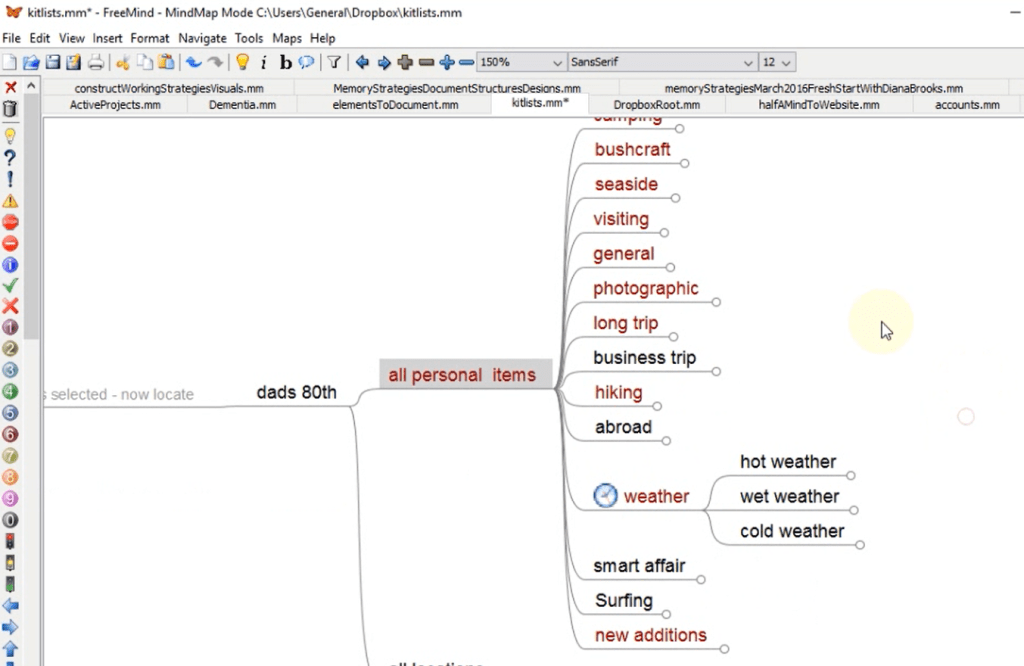
I did not begin each trip with a blank page and try to remember a packing list. I had reusable collections: personal items, group items, photographic equipment, hiking, business trips, hot and wet weather, and other categories built up from experience. For a new trip I could copy relevant material into a new event and then prune it.
That changes the mental question from ‘What do I need to remember?’ to ‘Which of the things I already know about apply this time?’ For me, that is a much easier problem.

The copied structure is not sacred. Things that do not apply are removed; things that do apply are highlighted. The general-purpose knowledge is progressively reshaped into the particular trip in front of me.
This is one reason I find the word ‘dynamic’ important. The map is not an archive that I merely consult. It is material that I manipulate while thinking.
Deal with uncertainty without stopping
Once I have selected what is needed, the next question may be: where is it? I use a locations structure containing places such as the study, bedroom, kitchen, bathroom, garage, car and Scout headquarters.
If I know where an item is, it can be placed beneath that location. If I do not know, it can go under a deliberately mundane but extremely useful branch: ‘Unsure’. That means not knowing where the gas-bottle spanner is does not have to derail everything else. The uncertainty has somewhere to live until I am ready to resolve it.

Some things need attention – but not yet
Timing is another kind of state. Weather-dependent equipment is an obvious example. Days before a trip it may simply be too early to decide whether I need hot-weather, wet-weather or cold-weather kit.
In FreeMind I could attach a reminder so that, at the appropriate time, the node and the path of nodes back towards the root would begin flashing. That mattered even when a branch was closed: the reminder could still draw my attention back towards the item that needed it. It allowed me, in effect, to tell myself: this matters, but I do not need to think about it yet.
The same technique could be used for other time-dependent jobs. In the old recording, for example, there is a reminder associated with treating boots with dubbin. The important point is not the flashing icon. It is the ability to hand a future responsibility to the working surface.
Reorganise the problem around the physical world
Once the items are associated with locations, the map changes the way I move through the real world. Instead of walking around according to whatever object happens to come into my head next, I can visit a location and deal with the things that are there.
The study may contain the tripod and waterproof notepad; the bathroom the razor and foam; the garage boot grips, survival bag and wet bags; the car the satnav. The map has reorganised a packing problem into a collection problem.
That matters because it can turn repeated wandering into purposeful visits. I can visit a location once, harvest what I need from it, update the map and move on. At the time I was doing this with a laptop rather than a phone or tablet, so I might carry it with me and update the map as I worked through the different locations.
Then change the question again
When the items have been located and brought together, the question changes. The 2016 map actually contains the phase description ‘items located – now pack items’. At that point the important structure is no longer simply where things came from. It is where they are going: the red rucksack, a leather holdall, compression sacks, perhaps even a particular side pouch.
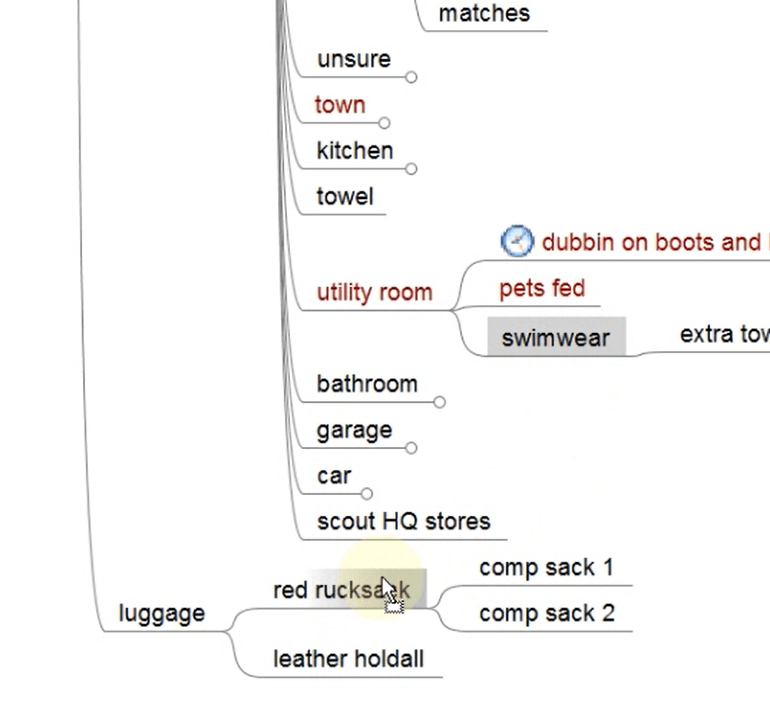
This is the part that makes the idea of a working surface with state especially concrete. The same real-world object can be represented first according to where I expect to find it and later according to the luggage into which I have packed it.
In the video, swimwear provides a wonderfully ordinary example. At one stage it belongs under its physical location. Later it moves under the red rucksack. If the exact compartment matters, the map can carry that level of detail too. That could save me from unpacking and rechecking pouches simply because I could no longer remember where something had gone. The representation changes because the state of the real task has changed.

The bee in the flower bed
I have come to think of the cursor rather like a bee moving around a flower bed. It does not have to hold the whole garden in mind. It visits one flower, does the work that belongs there, and moves on.
The metaphor is not exact, but it captures something important about the way I work. I do not need to race mentally around the entire map. I can visit one node at a time. The map holds the wider structure while the cursor gives me a local place to work.
Sometimes there are several cursors, each with a different job: one might record where I have reached in selecting luggage while another holds my place in packing it. The cursor is simply a node, but by giving it a conspicuous style and a meaningful name I can make it act like a bookmark with a purpose.

What did all this buy me?
In the 2016 recording I estimated that the structured process took roughly an hour and a half to plan and about an hour to pack, and that I could finish feeling reasonably okay. Before developing it, I could spend the whole day gathering things more randomly, checking and rechecking, packing and sometimes unpacking because I could no longer be sure what I had done.
That comparison matters more to me than whether the mind map looks elegant. The purpose of the technique is not to produce a clever diagram. It is to make an otherwise cognitively punishing activity manageable, and to leave some usable energy for what comes afterwards.
More importantly, these ways of working helped make possible thirty years of Scouting — years of camps, adventures and shared experiences with my boys that became some of the richest memories of my life.
Beyond packing
The packing example is unusually easy to see because objects physically move as the map changes, but the underlying approach is not really about luggage.
I have used mind maps to investigate technical problems, to compare choices and to work through purchasing decisions. In deep system testing, for example, a map could help me preserve the path of an investigation through layers of software rather than relying on my working memory to hold the trail.
The same general pattern can appear when choosing between products. Information can be collected against competing options and the structure changed as the decision develops. The details differ, but the principle remains: get the work out of my head and onto a surface that can remember its evolving state.
Problems have shapes
This has led me towards an idea that I am still exploring: problems have shapes.
I do not yet mean a neat catalogue of five diagrams into which every problem can be placed. The idea is more tentative than that. But looking back at these old working maps, I can see recurring structures in the way problems unfold.
The packing map repeatedly reorganises the same information to answer a succession of different questions: What might I need? What do I need this time? Where is it? Where should I gather it? Which bag does it belong in? Is it packed?
At each stage the problem has, in a practical sense, changed shape. The useful organisation for one stage is not necessarily the useful organisation for the next.
That may turn out to be a broader principle. Two activities that look completely different on the surface may share an underlying shape; two apparently similar jobs may demand quite different structures. I am interested in finding out whether recognising those shapes can help us build better external ways of thinking.
So this part of the story is unfinished. Rather than pretending that I already have a complete theory, I would rather take readers with me while the idea develops.
Thinking surfaces, not clever diagrams
Mind maps are often presented as a way to organise ideas. For me they became something more useful: a place where part of the act of thinking could happen.
The particular software is old. Some of my maps are untidy. The methods grew pragmatically rather than from a grand design. None of that troubles me very much.
What matters is that when my head could no longer reliably carry a complicated task, I found a way to give the task somewhere else to live.
And once it lived outside my head, I could visit it one piece at a time, leave it safely when interrupted, and come back to find that it still knew where I had got to. Many of those old maps still exist; even years later, their structure can preserve enough of the task for me to find my way back into it.
posted 15/8/2026


Leave a comment