In Brief
Moving house meant finding new locations for hundreds of familiar possessions, a considerable challenge when memory and fatigue make changing details difficult to track. By recording spoken descriptions of what I packed and asking ChatGPT to organise them, I created something more useful than a conventional inventory. I could ask ordinary questions about where things were, even when I couldn’t remember exactly how I had described them
Too Much to Hold
Moving house creates a particular kind of memory problem. Familiar objects stop having familiar locations. Something that normally lives in a drawer may be packed in a basket, moved into a numbered box and then transferred to another house. Some things are packed early; others must remain available until the final morning. Plans change, and the record needs to change with them.
That could be difficult for anyone. For me, with limited working memory and the effects of fatigue, trying to keep this changing network of objects and locations in my head was unrealistic. I needed to move the information outside my head, but I also needed a way of recording it that would not make packing considerably harder.
Typing a careful inventory of every box was not practical. Instead, I spoke descriptions into an app called Just Press Record while I was packing. Although I often use the app on my Apple Watch for quick captures, I generally use my iPhone for this sort of task because its microphone produces better-quality recordings.
I pasted the transcripts into ChatGPT, which turned my untidy spoken accounts into more orderly records of box contents. The transcripts were not always accurate. My diction can be unclear, particularly when I speak quickly, and packing sometimes meant dictating in mid-movement, with background noise. Object names, box numbers and unfamiliar words could be misheard. ChatGPT could often make sense of the surrounding context and correct those transcription errors. Reviewing the organised record therefore remained an important part of the process.
The method gradually settled into four steps:
- Speak: Describe what I am packing in whatever words come naturally.
- Tidy: Ask ChatGPT to turn the transcript into a structured inventory.
- Review: Correct mistakes and update the record when I move something from one recorded location to another.
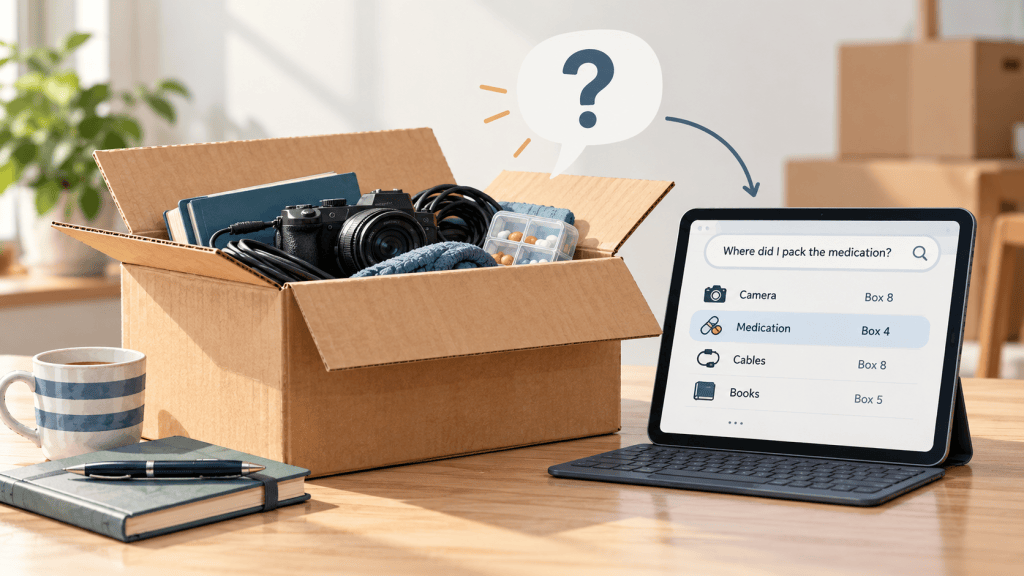
- Ask: Later use an ordinary question, such as “Where did I pack the Sharpies?”
I did not need to remember a special command, search through a spreadsheet or know exactly how an item had originally been described. I could begin with the words that came to mind and have a conversation with the record.
Putting the Memory to Work
The real test came when I began asking the record where things were. Some searches produced precise answers. The blood pressure monitor was recorded in Box 8. The nail clippers were in Box 4. The television remotes had been placed in a grey picnic bag. That last location sounds rather odd, but I suspect the remotes were packed at the very end, after most boxes had been sealed, because we had still been using the television.
At other times, including my search for the medication, the answer was less exact. But the information still gave me enough of a clue to recognise the likely location.
This was quite different from searching an ordinary list. I did not have to remember which box to inspect, or even the exact words I had used when packing. I could ask “Where is the blood pressure monitor?” or “Do we know where I packed the nail clippers?” ChatGPT could interpret the question, search the recorded descriptions and give me the most likely answer.
I did not need to remember where I had packed something. I only needed to remember that I had probably recorded it. ChatGPT could then help me recover the missing detail.
What the Record Cannot Show
The system also demonstrated its limitations after the move. I wanted to find some lens wipes that I believed I had packed at the old house. I asked whether they appeared either in the packing records or in the new inventory of objects already unpacked in the new house. They did not.
An external memory can retrieve only information that reached it in the first place. The wipes may have been packed without being mentioned, described under an unexpected name, or placed somewhere during the final rush. ChatGPT could search the available records and suggest possibilities, but it could not manufacture a location that had never been recorded.
Even that negative answer was useful. It told me that repeatedly searching the same inventory was unlikely to help. The answer might instead emerge as I continued recording the contents of drawers, cupboards and storage furniture in the new house.
The lesson was not that the record had failed. It was that its boundary had become visible. It could remember what I had told it, help interpret imperfect descriptions and identify gaps, but it could not observe what I had never captured.
A Memory I Could Question
The inventory did not remove the confusion of moving house, and it did not record every object perfectly. What it did was to reduce the amount of changing detail that I had to hold in my own mind.
My study was by far the most complicated room to pack and unpack. It contained photography equipment, cycling accessories, computer equipment, documents and a great many small objects. My wife took on most of the work of finding homes for things elsewhere in the house. Fatigue and brain fog meant I could not keep going for the sustained periods that she could. But I could take responsibility for the study, recording and checking where its contents went as I worked. Without that process, the task might have dragged on for weeks, or I might have needed to ask her to take on even more.
Even after unpacking, the new locations will take time to learn. As I write this, I am sitting with a pot of tea. My wife has done an enormous amount of work finding sensible homes for our belongings. I managed to retrieve the tea cosy, but by the time I needed to put it away, I had already forgotten where its new home was.
That tiny incident captures the continuing problem. I do not yet have a reliable internal map of where everything lives. By recording what is stored in each drawer, cupboard and storage unit, I am allowing the packing inventory to develop into an external memory for the new house.
I no longer need to remember both an object and its location. I need only remember that I have probably recorded it. I can then ask a question in whatever language comes naturally to me, even if that language does not exactly match the original description.
A conventional list stores information, but it still expects me to search it successfully. This record allows me to begin with an uncertain thought — “Where did I put the medication?”, “Did I record the lens wipes?” or “Where does the tea cosy live?” — and use a conversation to explore what is known.
The medication search showed why that mattered. The record was incomplete and its answer was indirect, but it gave me enough information to act. It did not need to be perfect to reduce my cognitive burden and make an important piece of information retrievable.
In a separate Strategy post, I will describe the practical method more fully: how I recorded the information, dealt with imperfect transcription, organised it and turned it into something I could question. For this scenario, the important discovery was simpler.
I had not merely made a packing list. I had made a memory I could question.