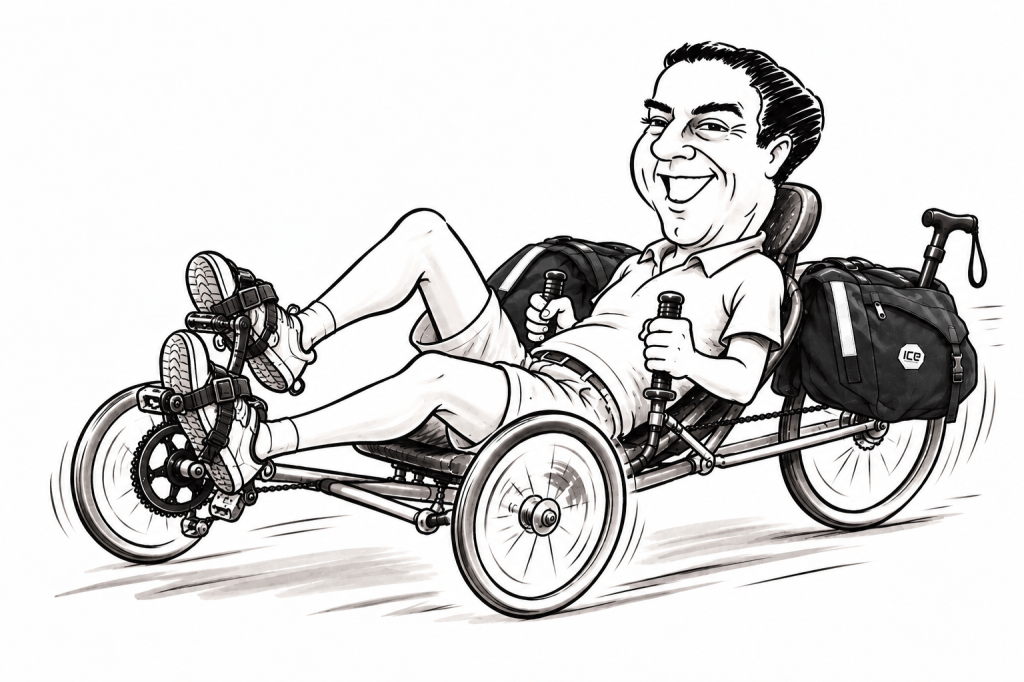
An extra wheel sounds like a small change. For me, it gave back far more than cycling.
That might have been the end of cycling. Instead, very shortly after the stroke, my son suggested that I try a recumbent trike.
I had been having problems with balance and proprioception – the sense of where my body and limbs are – for years before my stroke. After the stroke, weakness and fatigue added to the difficulty. An ordinary bicycle had become an unforgiving proposition. If I wobbled or stopped awkwardly, there was very little margin for error.
Three wheels change the problem
My ICE Adventure recumbent trike has two wheels at the front and one at the back. I sit in a supportive seat, with my legs extended towards the pedals and a steering handle beside each hand. Most importantly, I do not have to balance it in the way I would balance a bicycle.
I can stop without having to get a foot down quickly. I can take time to look around. The electric assistance helps me manage hills, weakness and fatigue, while I still provide the pedalling. Those differences turn something that had become risky into something I can use with confidence and great enjoyment.
My trike was also fitted with ICE Helping Handles and adaptive pedals. The handles give me something secure to use when getting into and out of the seat, while the pedals help keep my feet safely positioned. They are small adaptations, but together they make the trike much more practical for me to use independently.
Riding together again
My son’s suggestion quickly became something we could do together. He rode my e-bike while I rode the trike, and not long after my stroke we were able to make very enjoyable trips together, eventually covering distances of up to about 25 miles.
That matters to me for reasons beyond exercise. I had not simply found a safer substitute for a bicycle. I was once again able to go out for a ride with someone else, travel a worthwhile distance and enjoy the journey rather than thinking of the whole thing as rehabilitation.
The machine was different, but the activity was recognisably cycling again.
There is still some of the simple thrill of cycling, too. I can lean into a corner and hear the automatic gearbox quietly doing its work, leaving me in the right gear to accelerate smoothly out the other side.
Exercise with somewhere to go
Rehabilitation exercise is valuable, but it can sometimes feel as though the exercise itself is the whole purpose. Riding the trike feels different. I am going somewhere, seeing what is around me and choosing what to do. The cardiovascular exercise happens along the way.
My son has also helped me use the trike more deliberately as part of rebuilding my strength. On selected hills I reduce or remove the electrical assistance and work my legs hard, sometimes until the muscles can do very little more. The assistance is still there when I need it, so the same machine can both compensate for my limitations and provide a controlled physical challenge.
I have been doing this as part of my exercise since the stroke. It is one of the things I like most about the trike: it can be transport, recreation and exercise at the same time.
The riding has helped me rebuild fitness that was already declining before the stroke. It also gets me outdoors and into nature. The effect on my mental wellbeing is at least as important as the physical exercise. The trike gives me independence, a reason to go out and the simple pleasure of moving through the landscape under my own power.
A platform for photography
Photography has been part of my life for a very long time, and the trike has created new ways for me to continue with it. I can carry equipment, travel along paths that offer photographic opportunities and stop to observe without first having to dismount and recover my balance.
That ability to stop is surprisingly important. On an ordinary bicycle, stopping and starting would now bring balance back into the problem. On the trike I can simply stop, remain seated, look around and decide whether there is a photograph worth making.
The trike is therefore not simply a way of reaching a location. It can become part of the way I explore and photograph it once I arrive.
The bike people notice
There is another benefit I had not expected: people notice the trike. Small children have pointed and announced to their parents that there is a “lying-down bike”. Teenagers have called out “cool bike”. Older adults often simply smile.
I cannot know what those smiles mean, but I sometimes wonder whether people notice the disability symbols I have fixed beneath the pedals and recognise something else as well: that disability has changed the way I ride, but it has not stopped me riding.
Those little encounters give me a lift. There is something rather pleasing about using adaptive equipment that attracts attention not because it looks medical, but because it looks interesting. Every now and then I ride past a Porsche and allow myself the thought that, on this occasion at least, mine may be the more interesting vehicle.
Technology around the edges
There is other technology involved too. I use my smartwatch and phone to record outdoor cycling workouts, just as I use them for exercise in the gym. Those devices help me keep a record of what I have done, but they are supporting actors in this particular story. The important change is still the extra wheel.
Other uses of the watch and phone – including navigation when I am exploring – solve different problems and belong in their own stories.
I first saw the recumbent trike as a practical answer to a balance problem. It has certainly been that, but it has also provided independence, exercise, better mental wellbeing, photography and companionship.
More than a substitute
Recovery is often described as regaining something that has been lost. Sometimes that is possible. At other times, the better answer is to find a different way to participate. My trike has not recreated ordinary cycling exactly as it was. It has given me a new version of it – and added opportunities that I did not have before.
One extra wheel turned out to give me rather a lot.
 Half a Mind to ..
Leave a comment