Some small problems are now too big to fit in working memory (Insight 040)
Before my brain injury, I rarely thought about thinking.
Like most people, I simply got on with it.
If someone asked me to multiply 17 by 13, I would mentally break the problem into smaller pieces. Ten times seventeen is 170. Three times seventeen is 51. Add them together and the answer is 221.
The arithmetic is straightforward. What matters is that the intermediate results have to be held somewhere while the calculation is being completed.
Read more: Small problems too big (Insight 040)I never noticed myself doing that. It was just part of how my brain worked.
These days things are a little different.
Following treatment for a brain tumour and, more recently, a stroke, I find it much harder to keep several pieces of information active in my mind at the same time. If I focus on one piece, another may quietly disappear. The problem itself has not changed, but my ability to hold the whole thing at once has.
Over the years I have gradually developed ways to compensate.
Lists help.
Notes help.
Calendars help
Whiteboards help
Mind maps help.
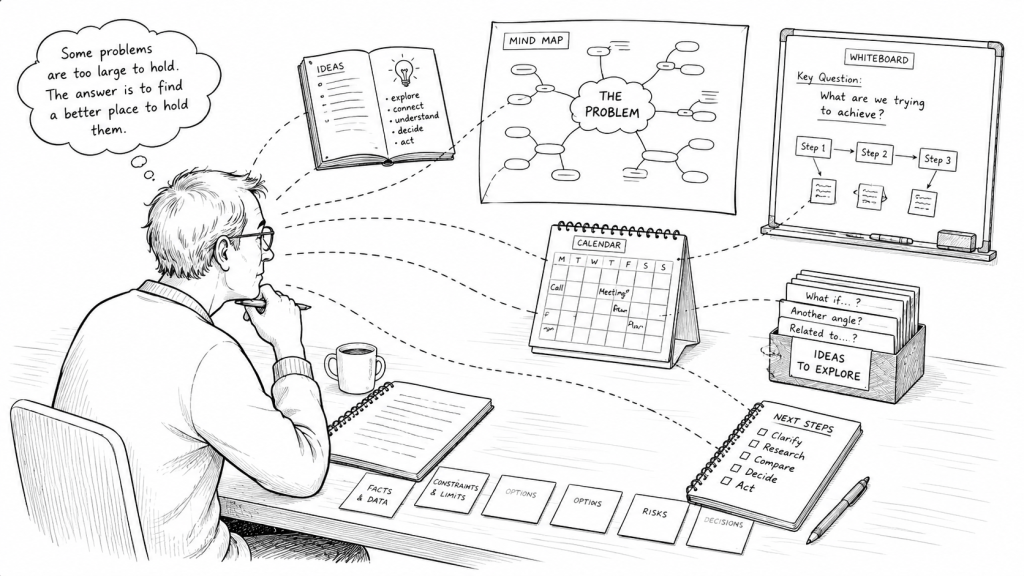
Each of these allows me to move part of the problem out of my head and into the world around me.
For a long time I thought of these things simply as memory aids. Increasingly, however, I think they are something more than that.
They are not just places to store information. They are places where thinking can happen.
A shopping list allows me to reason about what I still need to buy.
A calendar allows me to reason about future commitments.
A mind map allows me to explore relationships that would otherwise be difficult to keep in view.
The tool becomes part of the thought process.
Recently I have found myself doing something similar with artificial intelligence.
Much of the discussion around AI focuses on whether it can replace human thinking. That has never been the interesting question for me.
What interests me is whether it can help me think.
When I am working through a complicated problem, the challenge is often not understanding any individual part of it. The challenge is keeping all the relevant pieces available at the same time.
AI can sometimes act as a temporary holding space for context. It can remember points that have already been discussed, help organise ideas, and allow me to explore a problem that might otherwise exceed the capacity of my mental workspace.
The result is not that the AI does the thinking for me.
Rather, the thinking becomes distributed between myself and the tools I am using.
The more I reflect on this, the more I wonder whether this is unusual at all.
Long before computers existed, people used notebooks, diagrams, sketches, filing systems, conversations and books. A mathematician might cover a blackboard with symbols. An engineer might spread drawings across a desk. A project manager might pin notes to a wall.
Perhaps they were all doing the same thing.
Perhaps they were extending their minds beyond the boundaries of their skulls.
Brain injury did not create that need for me. It merely made me aware of it.
My old brain could hold larger and more complicated structures internally. My new brain often cannot. As a result, I have become much more conscious of the value of external tools.
What once happened invisibly now happens in plain sight.
That has led me to a simple conclusion.
Some problems are too large to hold in memory .
The answer is not always to make the problem smaller.
Sometimes the answer is to find a better place to hold it
Related Posts
Ideas Taking Shape
Insight 140: the insight that problems have shapes.


Leave a comment